We scanned 3,059 small-business websites for AI chatbots. We confirmed one.
An original scan of independent restaurants, dentists, law firms, shops, salons and garages in six U.S. metros found almost no AI on their homepages. Only 2.3% ran any third-party chat widget at all.
Disclosure: This scan used EverThread Dart, a business-website scanner made by EverThread. EverThread and The Parameter are both owned by PB Digital LLC.
Drafted by The Parameter's AI desk and reviewed by PB Digital before publication.
AI vendors talk about small businesses as their next big market. On the websites of small businesses themselves, AI is close to invisible.
The Parameter scanned the homepages of 3,059 independent businesses in six U.S. metros on Nov. 24: restaurants, dentists, law firms, retail shops, salons and spas, auto repair shops, and plumbers, electricians, HVAC and roofing companies. We looked for the code of known AI chatbot and chat-widget products. The scan flagged four sites for an AI chatbot. When we checked each one by hand, one was a dedicated AI chatbot (a Wonderchat widget on a law firm's site) installed by an independent business. That is one site in 3,059, or 0.03%.
Of the other three, two belonged to national retail brands that slipped into our sample because OpenStreetMap had not tagged them as chains. The third listed an AI vendor's domain in a security allowlist, with no widget on the page.
Chat widgets of any kind are rare
AI chat aside, ordinary chat widgets are rare too. Only 69 homepages, or 2.3% (95% confidence interval 1.8% to 2.8%), loaded a third-party chat widget of any kind. The most common were tawk.to (19 sites), Zendesk (12), Gorgias (9), HighLevel's LeadConnector widget (9), LiveChat (5) and Tidio (4).
Several of those vendors now sell AI agents that answer inside the same widget, including Intercom's Fin, Tidio's Lyro, Zendesk's AI agents and Gorgias's AI Agent. A script tag does not show whether a business has switched the AI on, so we counted these as chat widgets, not AI. Even if every one of the 69 had the AI turned on, AI chat would still reach fewer than one in 40 of these sites.
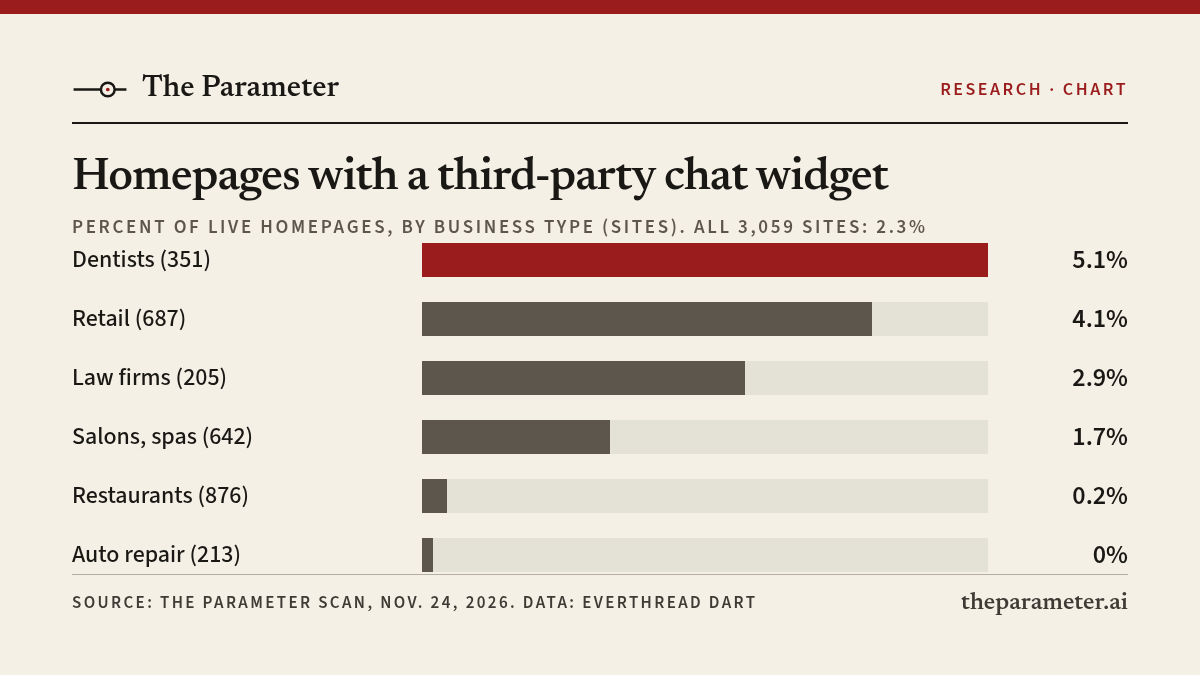
Dentists (5.1% of 351 sites) and retail shops (4.1% of 687) used chat the most. Restaurants used it the least, with 2 widgets across 876 sites (0.2%). None of the 213 auto repair shops had one. The home services group was small (78 sites), so its 5.1% rate is less certain.
The website builder makes a difference
Shopify stores were the most likely to carry a chat widget: 25 of 342, or 7.3%. Next came WordPress sites (25 of 901, 2.8%) and Squarespace sites (2 of 451, 0.4%). None of the 175 Wix sites loaded one of the widgets we track. Wix has its own built-in chat tool, which our scan does not count, so these figures cover third-party widgets only.
Two more homepages linked to ChatGPT. Those were links, not chat tools on the site, so we did not count them.
Methodology
- Sample. We used OpenStreetMap to find every business of these types inside each metro's bounding box (Atlanta, Chicago, Denver, Indianapolis, Portland, Ore., and Seattle) that listed a website and carried no brand or chain tag. Each business type was capped at a random 250 sites per metro. The cap applied to restaurants in five metros and to retail and salons in Portland and Seattle. That gave 4,370 candidate sites. Of those, 3,059 returned a working homepage (HTTP 200). The rest failed to load, timed out, or refused our request. Austin and Phoenix were in the original design, but the public map servers timed out on both, so they are not in the results.
- Scan. We used EverThread Dart, a business-website scanner, run from our own machine. It made one polite request per site for the homepage only. It did not probe any other pages and collected no security information.
- Detection. Dart searched each homepage's raw HTML for the script addresses of more than 40 chat and AI-agent products, including Chatbase, Voiceflow, Botpress, Intercom, Drift, Zendesk, Tidio, LivePerson, HighLevel, Podium, tawk.to and Ada. We dropped or narrowed three rules after spot checks showed false matches. We also checked every AI hit by hand.
- Limits. This is a lower bound for what is visible in homepage code. We would miss widgets loaded only through a tag manager, only after a visitor clicks, or only on inner pages, as well as AI phone answering, which leaves no trace on a website. OpenStreetMap lists only some businesses, and its coverage of each business type varies. Six metros are not the whole country. We report totals only and do not name any small business.
The figures are available as a summary CSV.
Why it matters
The AI-agent pitch to small businesses is everywhere. But on the websites of these 3,059 independent businesses, it has barely shown up. If AI is reaching Main Street, it is not yet through the chat box on the homepage. Further runs of this scan can show whether that number moves.
Sources
- Summary data for this study (CSV) — The Parameter, Nov. 24, 2026
- EverThread Dart (scanner used for this study): EverThread, a PB Digital company.
- OpenStreetMap (business listings and website tags), via the Overpass API — OpenStreetMap contributors, ODbL
- Fin, Intercom's AI agent — Intercom
- Lyro AI agent — Tidio
- AI Agent — Gorgias
- AI agents — Zendesk
Updated 25 Nov 2026 to add a disclosure of The Parameter's ownership relationship with EverThread.
The Parameter reports only what its sources support. Corrections and how we work: editorial policy or hello@theparameter.ai.