Google's Gemini 4 Hydrogen is built for fast everyday work, at Flash's future price
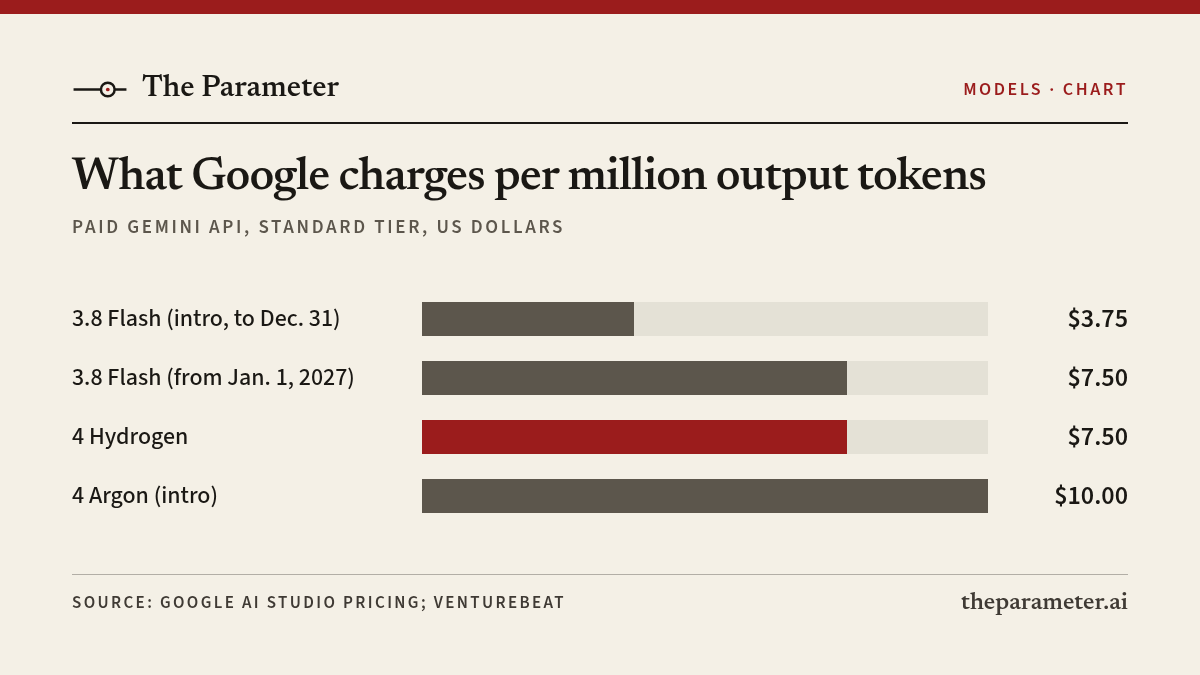
The new model is rolling out across the Gemini API, the Gemini app, and Search. It costs $1.50 per million input tokens and $7.50 per million output tokens, double Gemini 3.8 Flash's current introductory rate.
Google on Thursday released Gemini 4 Hydrogen, a model meant for fast, routine work: writing code, running tests, working through documents, and powering AI agents that take several steps to finish a task. Google's larger Gemini 4 models, Carbon and Argon, remain its choice for long, difficult reasoning. Hydrogen is the one it is putting in front of the most people.
Where it is available
Google says Hydrogen is rolling out globally in the Gemini API and Google AI Studio, including the free tier, Gemini for business, the Gemini app, and Google Search. Free Gemini app users get it through automatic model selection when the app decides it fits a prompt. Paid Google AI Pro and Ultra subscribers can also use it in Google Antigravity, the company's coding environment.
What it costs
On the paid API tier, Hydrogen costs $1.50 per million input tokens and $7.50 per million output tokens, flat across its 1 million-token context window. Cached input costs $0.075 per million tokens. Google notes that thinking tokens are billed as output.
That is not cheap for a "fast" model. VentureBeat points out that it matches the standard price Google has scheduled for Gemini 3.8 Flash starting January 1, 2027, and is twice Flash's introductory rate, which runs through December 31. VentureBeat also reports that Google's Batch and Flex tiers cost half the standard rate, and that Hydrogen costs 15 times as much per token as the lowest standard rates for small models from Anthropic, OpenAI, and Meta.
What Google claims it can do
All performance figures here come from Google or from benchmarks Google cites; we have not tested the model.
- Speed. Google says Hydrogen finishes tasks 2.5 times faster than Gemini 3.8 Flash at its default setting.
- Agent work. On Terminal-Bench 4.1, which tests whether a model can complete tasks in a computer terminal, Google reports 57% for Hydrogen versus 18.2% for Flash. VentureBeat notes that Google's own table still shows Anthropic's Claude Sonnet 5.5 ahead, at 63.9%.
- Independent scoring. Google says Hydrogen scores 51 on the Artificial Analysis Intelligence Index at its default "high" thinking level, one point above Gemini 4 Argon, and 54 at its new "xhigh" setting. VentureBeat reports that Flash scored 31.
- Reliability. Google says Hydrogen produces fabricated claims more than five times less often than Flash and recovers better when a tool call fails or a search comes back empty.
The model has four thinking levels: low, medium, high (the default), and xhigh. Developers moving from Flash should note the default change. Hydrogen starts at high, where Flash started at medium, so the same prompt can use more output tokens unless the level is set lower.
Google also introduced Orchestrator in Antigravity, which switches between Carbon and Hydrogen within one session. On Terminal-Bench 4.0, Google says it came close to Carbon's success rate while using 24% less quota and finishing 19% faster.
Why it matters
Most AI usage is not frontier research. It is code edits, document summaries, and agents running the same steps over and over, so the model that handles that work sets most of the bill. Hydrogen is Google's bet that customers will pay more per token for a model that gets the job right in fewer tries.
Whether that bet pays off depends on the workload. A model that costs twice as much per token can still be cheaper per finished task if it needs fewer retries, which is what VentureBeat's comparison of estimated cost per benchmark task suggests for some workloads. Teams on Flash have until the end of the year, when Flash's introductory pricing ends, to test that against their own usage.
Sources
- Introducing Gemini 4 Hydrogen — Google, Nov. 12, 2026
- What's new in Gemini 4 Hydrogen — Gemini API documentation
- Gemini Developer API pricing — Google AI Studio
- Google launches Gemini 4 Hydrogen — a faster, smarter, pricier Flash successor — VentureBeat, Nov. 12, 2026
The Parameter reports only what its sources support. Corrections: hello@theparameter.ai.