OpenAI says GPT-6 designed proteins that bound their targets in lab tests
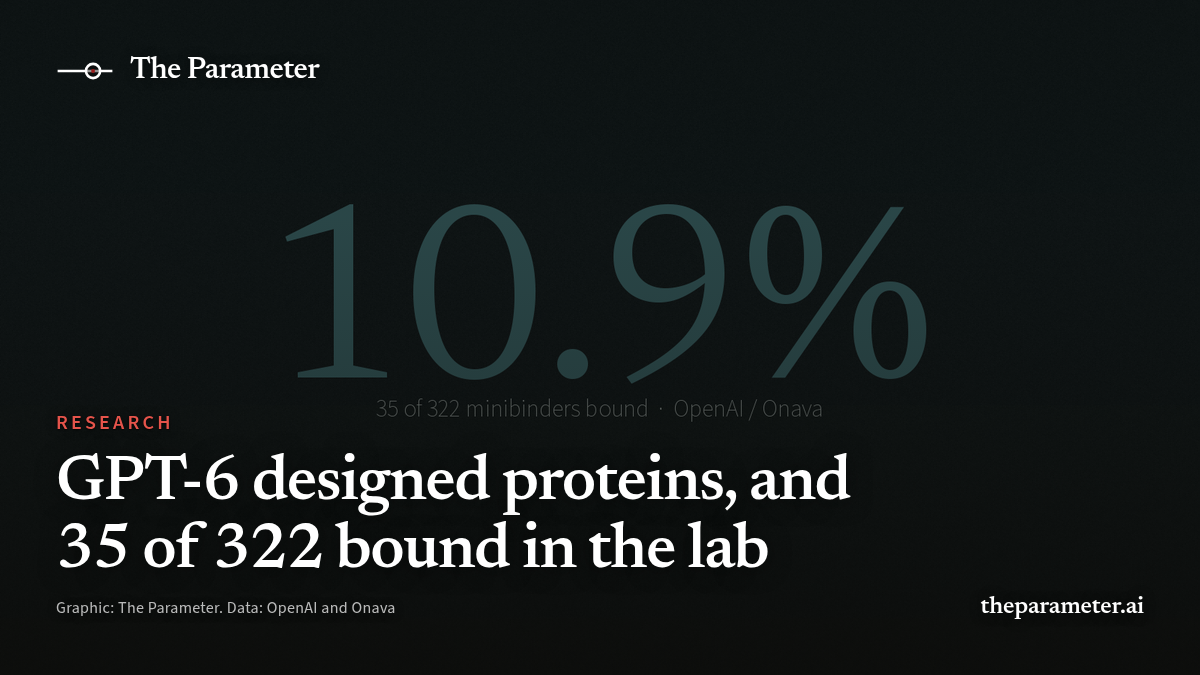
In tests with Onava, 10.9% of 322 minibinders based on GPT-6.2's designs showed evidence of binding across five targets. Specialized models still helped supply sequences and pick the candidates.
Drafted by The Parameter's AI desk and reviewed by PB Digital before publication.
OpenAI on November 24 said its GPT-6 models can design new protein shapes, and the amino-acid sequences that make them, using only reasoning and general-purpose coding tools. The company published the claim in a preprint, GPT-6 as a Universal Foundation Model for Protein Biology: Beyond Specialized Models, and in a research post the same day.
The distinctive claim is that the models do not have to call specialized biology systems to generate those designs. An internal research model, OpenAI said, matched or outperformed specialized tools on many protein-design tasks, and researchers could steer a design by prompting the model on where a protein should attach and what shape it should take.
What the lab tests showed
The more concrete evidence is wet-lab work with Onava, a research partner. Onava made small proteins, called minibinders, from three-dimensional structures designed by a pre-released version of GPT-6.2. Specialized models supplied amino-acid sequences and helped select which candidates to test.
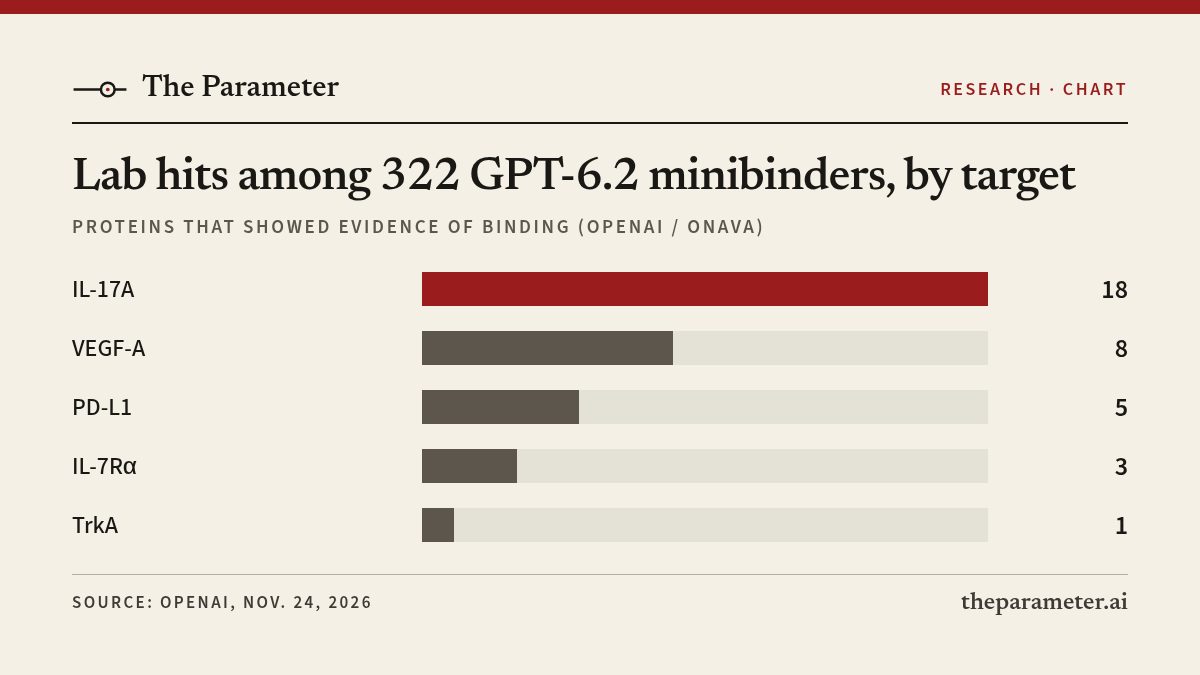
Of 322 minibinders tested against five targets, 35 (10.9%) showed evidence of binding: 18 for IL-17A, 8 for VEGF-A, 5 for PD-L1, 3 for IL-7Rα, and 1 for TrkA. OpenAI said at least one protein bound in each of the five groups. In separate experiments, it said, GPT-6.2 also redesigned sequences for existing minibinders and antibodies, and many of those retained binding after a similar selection step.
OpenAI compared the result with earlier work on RFdiffusion, a specialized design model, which reported higher hit rates. The company noted that hit rates depend heavily on how strictly researchers filter designs before lab tests, and on how they define binding.
The limits OpenAI is naming
The same post is careful about what this is not. The lab campaign used specialized structure-prediction models, including Boltz-2, OpenDDE, and ESMFold2, to filter candidates. The results, OpenAI said, do not show that GPT-6 can generate de novo minibinders end to end, in a zero-shot setting, without help from those tools.
Predicting a complete protein structure from its amino-acid sequence also remains a weakness. Even the best internal models, the company said, were "well behind" specialized structure-prediction systems on that task. Some high scores on inferring sequences from structures "may partly reflect memorization" of how those structures were generated.
Binding, the post added, is only one step toward a useful research tool or a medicine. Specificity, stability, biological activity, safety, and efficacy were not established. OpenAI also flagged biosecurity risk and said its Preparedness Framework guides how it assesses those risks.
Nature, reporting the same day, described the work as a proof of principle. Joy Jiao, who leads life-sciences research at OpenAI, told the journal the aim is for a scientist to describe a desired molecule in natural language and have a model design candidates to test. Some outside researchers, Nature noted, question how much of the apparent skill is genuine understanding of protein biology and how much is regurgitation of training data.
Why it matters
A general-purpose model that can be prompted in plain language, and then produce protein designs that sometimes bind in the lab, is a real shift in how this work might get done. It is also early. The hit rate is modest, specialized models still sat in the pipeline, and binding is not a drug. The useful test is whether later rounds can raise that rate, and drop the extra tools, without papering over the gaps OpenAI has already listed.
Sources
- GPT-6 models demonstrate intrinsic protein-design capabilities — OpenAI, Nov. 24, 2026
- GPT-6 as a Universal Foundation Model for Protein Biology: Beyond Specialized Models (preprint) — OpenAI, Nov. 24, 2026
- Watch out, AlphaFold: Claude and ChatGPT’s new biology skills wow scientists — Nature, Nov. 24, 2026
The Parameter reports only what its sources support. Corrections and how we work: editorial policy or hello@theparameter.ai.