Optimizely says attackers abused a signup flaw to plant a card skimmer on customer websites
For about 14 hours on Nov. 16, injected code in Optimizely Web Experimentation ran in visitors' browsers on affected sites. The company says the flaw is closed and the code is gone. Researchers counted 178 affected organizations.
Disclosure: This article cites notices published by EverThread, which, like The Parameter, is owned by PB Digital LLC.
Drafted by The Parameter's AI desk and reviewed by PB Digital before publication.
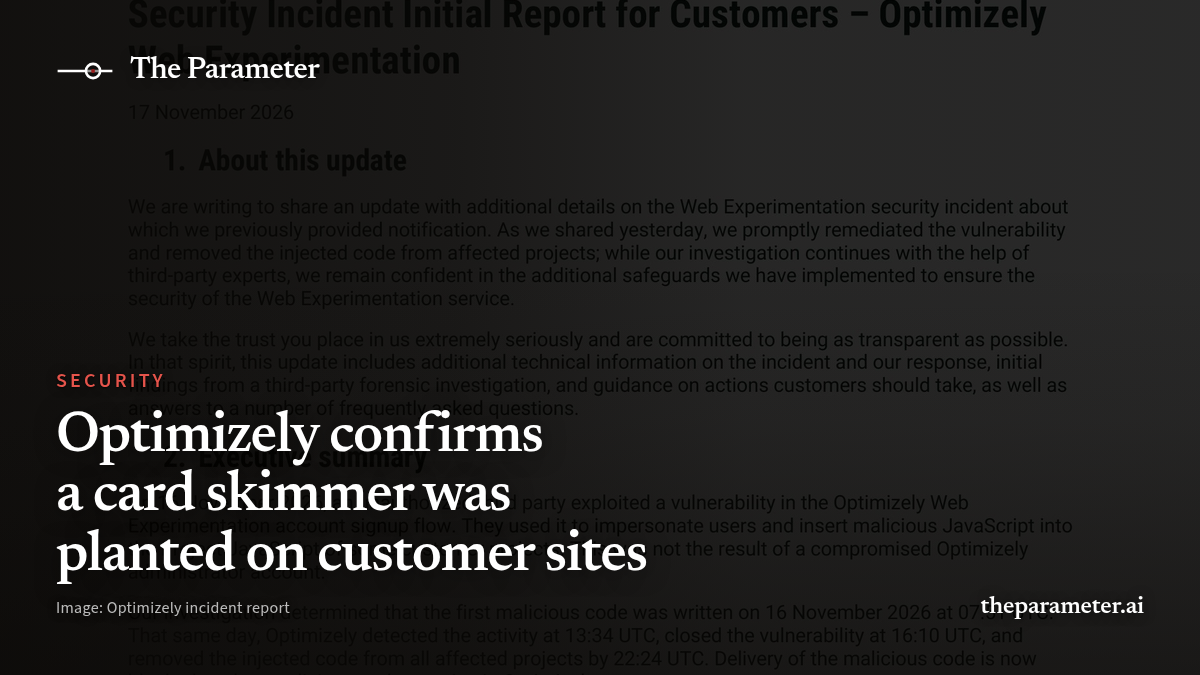
Optimizely, whose Web Experimentation product lets companies run A/B tests and change live web pages without a code release, says an unauthorized party used a flaw in the product to insert malicious JavaScript into some customers' websites on Nov. 16. The code tried to capture payment card details and redirect cryptocurrency transfers from visitors to those sites.
The company disclosed the incident on its status page Monday evening and published a more detailed report for customers on Tuesday. It says the flaw is fixed, the injected code has been removed and no malicious code remains in its systems. Mandiant is conducting an independent forensic investigation.
What Optimizely says happened
According to Optimizely's report, the attacker exploited a vulnerability in the Web Experimentation account signup flow. That let newly created accounts act as existing administrator users on customer accounts, using "a combination of public information and brute force." Acting as those administrators, the attacker edited the custom code field, called Project JavaScript, in targeted projects.
Optimizely says this was not a credentials breach. No passwords were stolen or used, no Optimizely administrator account was compromised, and customers do not need to reset passwords or API tokens.
The company's timeline, converted to Eastern time:
- 2:51 AM, Nov. 16: first malicious code written to a customer project
- 8:34 AM: activity detected
- 11:10 AM: flaw closed
- 5:24 PM: injected code removed from all affected projects
Only Web Experimentation was involved, Optimizely says. Feature Experimentation, its SDKs and legacy Full Stack were not affected.
What the code did
Optimizely says the injected script targeted card numbers and expiry dates typed into forms on the sites themselves, and swapped cryptocurrency wallet addresses. Cards entered in hosted payment frames, such as Stripe or Adyen, were out of its reach, and sites with a strong Content Security Policy blocked it. On older iPhones and iPads (iOS and iPadOS 18.6 and earlier), it loaded a second-stage script that attempted to install an exploit kit.
Researchers at Report URI, who flagged the attack, counted 178 affected organizations. Report URI's Scott Helme told The Record that 32 were finance or banking sites, that the firm traced at least $7,000 in stolen cryptocurrency on the blockchain, and that there is no way to see how many cards were skimmed or devices infected. Before Optimizely published its report, Helme wrote that it was not known how the attacker gained write access to so many unrelated customer projects, Ars Technica reported. Optimizely's report attributes it to the signup-flow flaw; its root-cause finding is still preliminary.
Attribution is pending. Optimizely says the attacker's infrastructure has hosted card skimmers used against other victims since at least September.
What affected companies and their customers can do
Optimizely says it has confirmed directly with each customer whether they were affected. It advises customers to check which pages ran the snippet during the exposure window, review payment and crypto transactions from that day, keep their logs, and consider their notification obligations with legal advisers. The report lists preliminary indicators of compromise for site owners.
For shoppers, there is no simple way to tell whether a site was affected. The usual steps apply: watch card statements and report charges you don't recognize to your bank. The issue was also listed in EverThread notices.
Why it matters
One vendor's script runs on thousands of websites, so a single flaw in that vendor can reach the visitors of companies that did nothing wrong themselves. Optimizely's own report says strong Content Security Policies and hosted payment fields stopped the skimmer where they were in place, which is the practical lesson for any site that loads third-party code on pages that take payments.
Sources
- Security Incident Initial Report for Customers: Optimizely Web Experimentation — Optimizely, Nov. 17, 2026
- Web Experimentation Security Incident — Optimizely status page, Nov. 17, 2026 (01:02 UTC)
- Website management platform Optimizely confirms hackers put malicious code into customer sites — The Record, Nov. 17, 2026
- Hundreds of websites deliver potent malware cocktail to unsuspecting visitors — Ars Technica, Nov. 17, 2026
- Optimizely Experimentation supply-chain attack (notice) — via EverThread notices
Updated 25 Nov 2026 to add a disclosure of The Parameter's ownership relationship with EverThread.
The Parameter reports only what its sources support. Corrections and how we work: editorial policy or hello@theparameter.ai.