U.S. closes the remote-access route to advanced AI chips for Chinese companies
A new Commerce Department rule requires licenses for overseas data centers that supply significant compute to China-headquartered firms, and adds license requirements for chip exports to five countries.
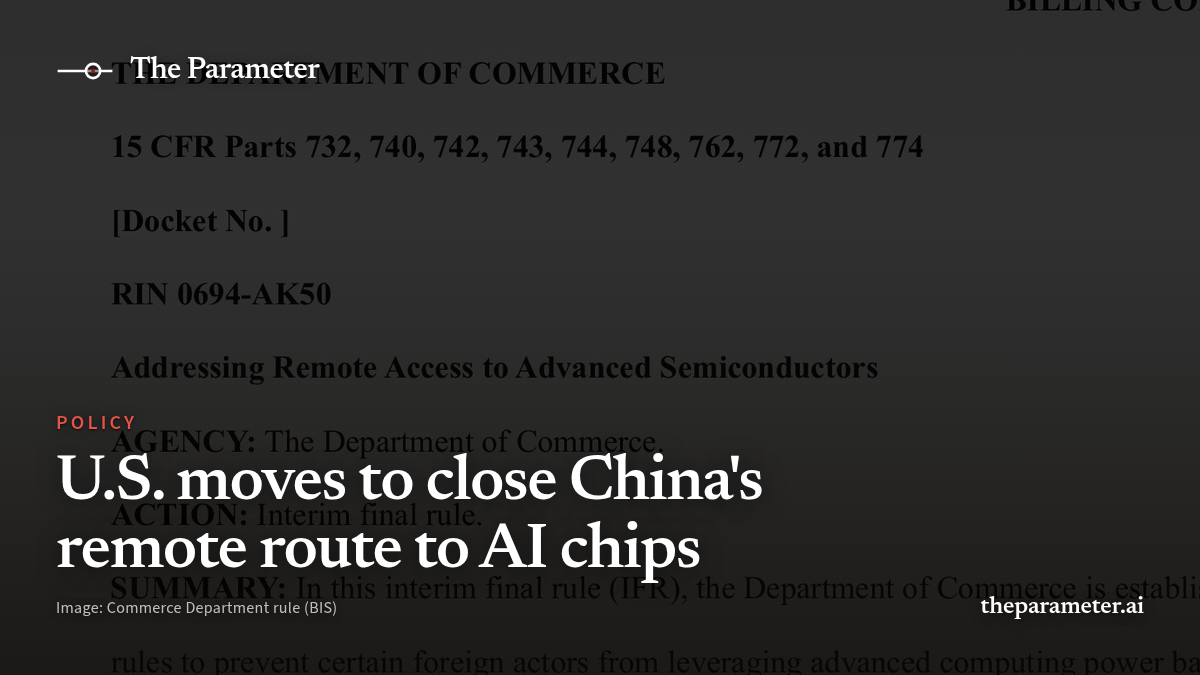
The U.S. Commerce Department on Monday released a rule aimed at a gap in its AI chip export controls: Chinese companies renting advanced American chips in data centers outside China. The interim final rule, issued by the Bureau of Industry and Security (BIS), was "written by and at the direction of the Department of Treasury and the National Security Council," according to the bureau's announcement.
BIS says the rule is meant "to ensure that existing restrictions on access to sensitive American technology cannot be circumvented through remote computing arrangements involving data centers in third countries."
What the rule does
The rule has four main parts, according to its text.
- A data center license requirement. Exporting advanced chips or servers to a data center anywhere in the world now requires a license if the exporter knows the facility supplies significant compute to companies headquartered in China, another Country Group D:5 destination or Macau. Law firm Nixon Peabody's summary puts the threshold at more than 12 million "aggregate TPP," a measure of total processing performance, counted at one facility or across linked data centers. Data centers already serving such customers must get a license within 90 days of the rule's effective date "or face future export restrictions."
- Five new license countries. Exports of advanced chips to Indonesia, Malaysia, Singapore, Thailand and Brazil now need a license. The rule calls them "countries which present a higher-than-normal risk of diversion." Chips bound for companies headquartered in the United States are exempt if reporting requirements are met.
- Tighter rules for chip designers in restricted destinations who use foundries and packagers in other countries.
- Formal repeal of the Biden-era AI Diffusion Rule, which BIS says was never enforced.
There is one carve-out: "commercial recommender systems," such as those used by online retailers and social media companies, are excluded because, the rule says, they "do not pose the same national security threat." Nixon Peabody notes the exclusion does not cover systems that generate text, images, code or other content.
The rule takes effect when it is published in the Federal Register. Nixon Peabody and Malaysia's The Edge say publication is expected on Nov. 19.
The context
Reuters reported that the rule arrived as President Trump began a trip to Asia that includes a meeting with Chinese President Xi Jinping in Shenzhen on Thursday. It also follows reporting, Reuters said, that Commerce had failed to curb Chinese access to overseas data centers. Former Commerce official Kate Koren told Reuters the rule would have "a much bigger impact on China" than adding a single company to the Entity List.
The rule says Commerce will monitor for countries that tolerate evasion and could respond with import restrictions, new license requirements or Entity List designations.
Why it matters
Until now, a Chinese AI company that could not buy top American AI chips could rent access to them in data centers in countries like Thailand and Malaysia, as Reuters described. This rule puts that rental market under U.S. licensing, and it puts the compliance burden on chip exporters and data center operators, who will need to know who their customers' parent companies are.
Sources
- BIS Issues Rule Addressing Remote Access to American Super Intelligence Technology — Bureau of Industry and Security, Nov. 16, 2026
- Interim final rule: Addressing Remote Access to Advanced Semiconductors (RIN 0694-AK50) — Department of Commerce, Nov. 16, 2026
- US to curb China's access to AI chips as Trump heads to Asia — Reuters (via Investing.com), Nov. 16, 2026
- BIS targets remote access to advanced chips through overseas data centers — Nixon Peabody, Nov. 16, 2026
The Parameter reports only what its sources support. Corrections: hello@theparameter.ai.