AI is now the top financial stability worry in the Fed's survey. Governor Barr explains why.
The Federal Reserve's November report found AI the most-cited risk, up from half of contacts in the spring. On Monday, Governor Michael Barr walked through the debt, the circular financing, and a new problem: AI agents in bank accounts.
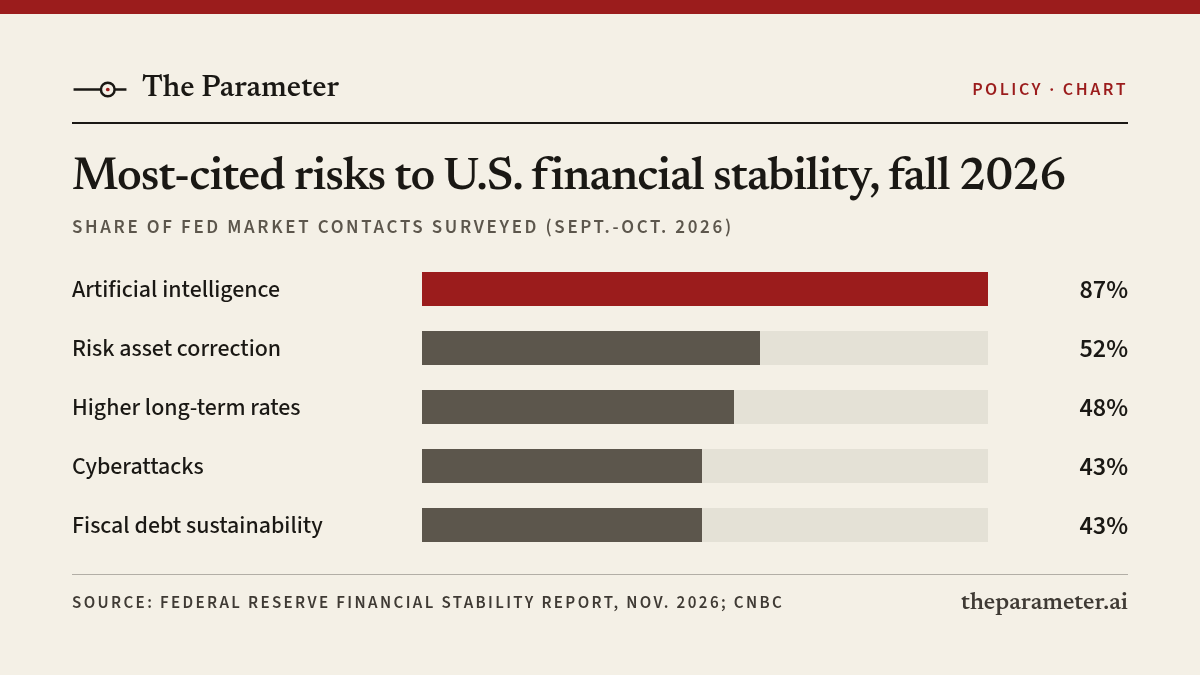
Artificial intelligence has become the risk most often cited by the market participants the Federal Reserve surveys about threats to the U.S. financial system. In the Fed's twice-yearly Financial Stability Report, released Friday, November 13, 87% of contacts named AI as a salient risk, up from 50% in the spring survey.
The next most-cited risks were a correction in risk assets (52%), higher long-term interest rates (48%), cyberattacks (43%) and fiscal debt sustainability (43%), according to the report and CNBC. The survey ran in September and October, and the report reflects data as of Oct. 28.
Respondents described three distinct concerns, the report said: elevated equity valuations and the chance that weaker-than-expected earnings trigger a correction; cyber risk "stemming from either a malicious attack by sophisticated state actors or damage caused by frontier AI models themselves"; and "risks associated with complex forms of AI-related financing."
Barr's reading of the numbers
On Monday, Fed Governor Michael Barr devoted a speech in Milan, at the ACM International Conference on AI in Finance, to the report's findings. He stressed that the views were his own.
Barr said on-balance-sheet debt at the seven largest AI firms is expected to exceed $800 billion before the end of the year. Their other obligations, including long-term contracts, leases and residual value guarantees, have grown faster: the report estimates the potential maximum value of these off-balance-sheet liabilities now exceeds $3 trillion. Reuters, citing the report, put advanced-computing debt issuance at $680 billion by October.
He also described "circular financing." Hyperscalers and chipmakers hold more than $100 billion in equity stakes in AI labs and cloud start-ups, which use the money to buy or rent compute from the same investors. For the buildout to pay off, Barr said, those smaller firms will eventually have to replace that funding with revenue from paying customers.
Barr was measured about direct losses. "Given the still-limited amount of debt backing the current boom, I'm less concerned about direct losses," he said, but added that high hedge fund leverage and risk appetite mean a sharp reversal could set off rapid deleveraging and fire sales.
Agents in customer accounts
The newest item in the speech concerned AI agents. Barr said "major banks now report finding AI agents attempting to take actions in retail customer accounts, without the bank being able to verify authenticity, consent, and alignment with customer instructions." He also warned that agents moving money automatically on yield or stability signals could speed up deposit runs "that unfold in minutes."
Why it matters
The Fed is not predicting a crash, and Barr said policymakers do not target market levels. But the central bank now treats AI as a financial-system issue, not just a technology story: the debt behind data centers, the guarantees large firms have written for weaker ones, and the arrival of agents that act on customers' money. Banks and agent builders should expect authentication and consent to become supervisory questions.
Sources
- Financial Stability Report, November 2026 — Board of Governors of the Federal Reserve System, Nov. 13, 2026
- Some Potential Financial Stability Implications of Artificial Intelligence (speech by Governor Michael S. Barr) — Federal Reserve Board, Nov. 16, 2026
- AI risks are biggest threat to the financial system, Fed survey finds — CNBC, Nov. 13, 2026
- AI rockets to top of worries about financial system in latest Fed survey — Reuters, Nov. 13, 2026
The Parameter reports only what its sources support. Corrections: hello@theparameter.ai.