Google's new test asks whether AI models get easy questions right every time
DeepMind's Humanity's First Exam scores a model only when it answers a simple question, and slight variations of it, consistently. On the live Kaggle leaderboard, GPT-6.2 Astra is first at 90.7%.
Drafted by The Parameter's AI desk and reviewed by PB Digital before publication.
Google DeepMind on November 24 launched Humanity's First Exam, a benchmark built to measure something most leaderboards ignore: whether a model can get a straightforward question right every time, not just once. Oran Kelly, a research scientist at DeepMind, announced the exam on Kaggle, with a technical report and a live leaderboard.
"Current frontier models excel at complex math, coding, and science," Kelly wrote. HFE is aimed at the opposite problem. The dataset has 544 elementary text and image prompts, grouped into 136 families of four — a seed prompt and three logic-preserving variants — across 20 foundational capabilities. The tasks include visual counting, color and symbol identification, spatial tracking, basic arithmetic, strict formatting, and spotting a false premise.
A model does not get credit for a lucky wording. Each prompt is sampled six times, independently, with no tools and no system message. To score a perfect Family pass⁴, it has to get all 24 of those attempts right: six draws across all four prompts in the family. DeepMind says four human raters solved each seed without calculators, search, or other tools (median time 1.5 minutes), and a family was kept only if at least three of the four got the seed right.
Who is ahead, on today's board
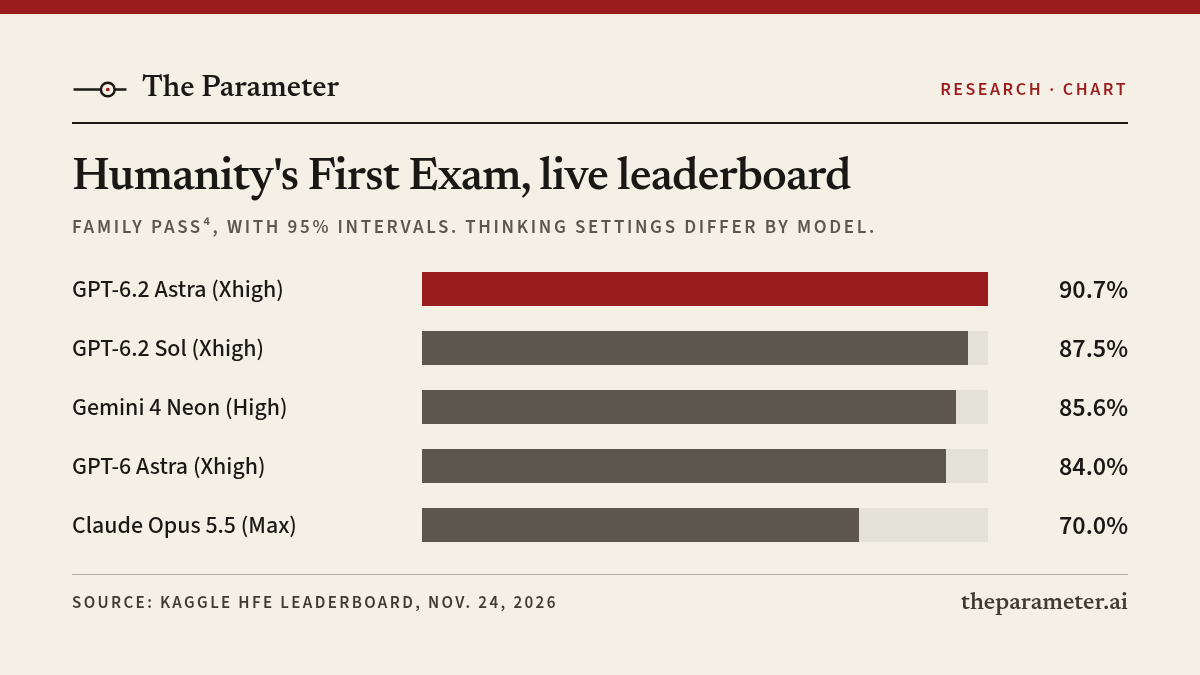
On the live Kaggle leaderboard on November 24, GPT-6.2 Astra led at 90.7%, plus or minus 4.7 points, at its Xhigh thinking setting. GPT-6.2 Sol was second, at 87.5% (±5.1), also at Xhigh. Gemini 4 Neon, run at High rather than Xhigh, was third at 85.6% (±5.7). GPT-6 Astra followed at 84.0%. Claude Opus 5.5, at Max, stood at 70.0% (±7.4).
Those intervals are wide, and the thinking settings are not identical, so small gaps should not be over-read. Google also publishes the benchmark and has its own models on the board. The ranking is DeepMind's official live table, not an independent third-party rerun.
Only a stratified 20% of the prompts — 112 items in 28 families — are public, under a CC-BY-4.0 license. The other 80% is held out, and official evaluation containers have no internet access. DeepMind says the public slice was chosen so that its ranking correlates closely with the full set (a Spearman rank correlation of 0.97, in the leaderboard documentation).
The company is also inviting outside contributions. A three-week Kaggle competition, running through December 15, asks people to submit everyday questions that today's models still get wrong, with the aim of keeping the exam from going stale.
Why it matters
Most AI scoreboards still reward a model for solving a hard problem once. Humanity's First Exam asks a blunter question: can it be trusted on the easy ones, repeatedly, when the wording or the picture shifts a little. A 90.7% lead is not a solved exam, especially with a 4.7-point margin and a publisher that also competes on the list. It is a clearer way to talk about reliability than another all-time-high on a contest problem.
Sources
- Humanity’s First Exam: Testing LLM reliability — Google DeepMind, Nov. 24, 2026
- Humanity's First Exam (HFE) leaderboard — Kaggle, accessed Nov. 24, 2026
- Humanity's First Exam technical report — Google DeepMind, Nov. 24, 2026
The Parameter reports only what its sources support. Corrections and how we work: editorial policy or hello@theparameter.ai.