Google's Gemini 4 Neon sits between Hydrogen and Carbon, at $3 and $15 a million tokens
The new model costs $3 per million input tokens and $15 per million output tokens, with a 1 million-token context window. Google puts it third on the Artificial Analysis Intelligence Index at its highest thinking setting.
Drafted by The Parameter's AI desk and reviewed by PB Digital before publication.
Google announced Gemini 4 Neon on November 18, a mid-range model it says is meant for complex coding, knowledge work, and scientific reasoning that has to run often, not just on the hardest jobs. Koray Kavukcuoglu, Google DeepMind's chief AI architect, wrote the post. The company last updated the page on November 23.
In Google's telling, Gemini 4 Carbon still handles the longest, most difficult projects, and Gemini 4 Hydrogen remains the fast model for everyday work. Neon, the model card says, is adapted from Carbon and is meant to sit between them: "frontier-level reasoning for complex, high-frequency workflows, faster and more cost efficiently."
The price, and where it runs
On the paid Gemini API, Neon costs $3 per million input tokens and $15 per million output tokens. Cached input is $0.15 per million tokens, which Google describes as a 95% discount. The context window is 1 million tokens, with default output of 64,000 tokens and long-decode generation of up to 1 million, according to Google's model list.
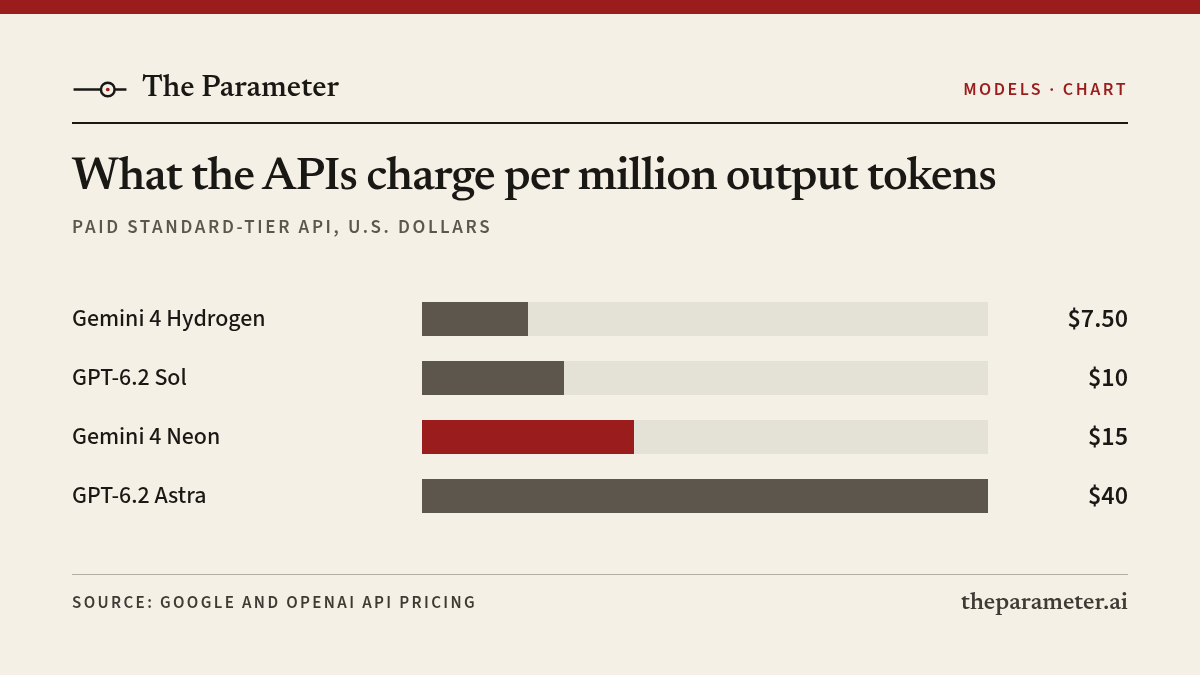
That is twice Hydrogen's output price of $7.50 per million tokens, and well below GPT-6.2 Astra, which OpenAI prices at $40 per million output tokens. Neon has four thinking levels — low, medium, high (the default), and xhigh — and Google says thinking tokens are billed as output, as they are on Hydrogen.
Access is limited. Google's changelog says Neon is generally available on the paid tier of the Gemini API. The blog post also lists Gemini for business, Google Antigravity for paid Google AI Pro and Ultra subscribers, and the Gemini app for those same paid tiers. The company did not describe a free-tier rollout.
The scores Google is citing
At its xhigh thinking level, Google says Neon scores 61 on the Artificial Analysis Intelligence Index, which would place it third, "just behind larger, slower models." On the Vals Index, Google puts it second, at 70.9%. The model card compares those figures with Claude Opus 5.5 (59 and 70.1%) and GPT-6.2 Sol (57 and 66.1%).
Google also says that, at the default high setting, Neon has a "32% lower cost per task than Carbon" on the Artificial Analysis index, and that it "sits on the Pareto frontier" on Vals and Agent Arena. Some of the sharpest jumps in the post depend on the harness: on SWE-sweep, the model card lists 12.8% with the mini-SWE harness and 39.0% "in Google Antigravity." Those are Google's numbers, including Google's own framing of third-party benchmarks. Independent checks over time will matter more than a launch-day leaderboard.
Why it matters
Neon fills an obvious gap in the Gemini 4 family: cheaper than Carbon, more capable, Google says, than Hydrogen, and priced to be used often. It is a paid product, not a free default, and several of the more striking coding results are tied to Google's own tools. The useful test is whether those scores, and that cost-per-task claim, hold up once people run Neon outside the launch benches.
Sources
- Introducing Gemini 4 Neon — Google, Nov. 18, 2026, updated Nov. 23
- Gemini 4 Neon model card — Google DeepMind, published Nov. 18, 2026
- Release notes — Gemini API — Google AI Studio, Nov. 18, 2026
- Latest Gemini models — Gemini API — Google AI Studio
The Parameter reports only what its sources support. Corrections and how we work: editorial policy or hello@theparameter.ai.