IBM trains small Granite models to tell instructions from data, cutting prompt injection in tests
Two experimental Granite 4.1 models use a markup language called LLMON to separate commands from content. IBM says it is a preview, not a guarantee.

IBM has released two experimental language models designed to address one of the most persistent security problems in AI agents: prompt injection, where a malicious instruction hidden inside a document, web page or tool result hijacks the model.
The models, granite-4.1-3b-LLMON-preview and granite-4.1-8b-LLMON-preview, are derived from IBM's Granite 4.1 base models. They are trained to read and write LLMON, short for LLM Object Notation, a markup language IBM researchers developed to make the structure of a prompt explicit to the model.
How it works
Most prompts mix instructions ("summarize this") with data (the thing to summarize) in one undifferentiated string of text. That is what makes injection possible: the model cannot reliably tell a command from content that merely looks like one.
According to IBM's post on the Hugging Face blog, LLMON wraps each part of a prompt in tags bounded by reserved special-token delimiters, marking what is an instruction, what is data and what is a requirement. Unique IDs let an instruction point to the exact data it should act on, which IBM likens to calling a function with arguments in a programming language. Anything reached as input, including documents, tool schemas and tool results, is meant to be treated as material to read rather than a command to follow.
What IBM reports
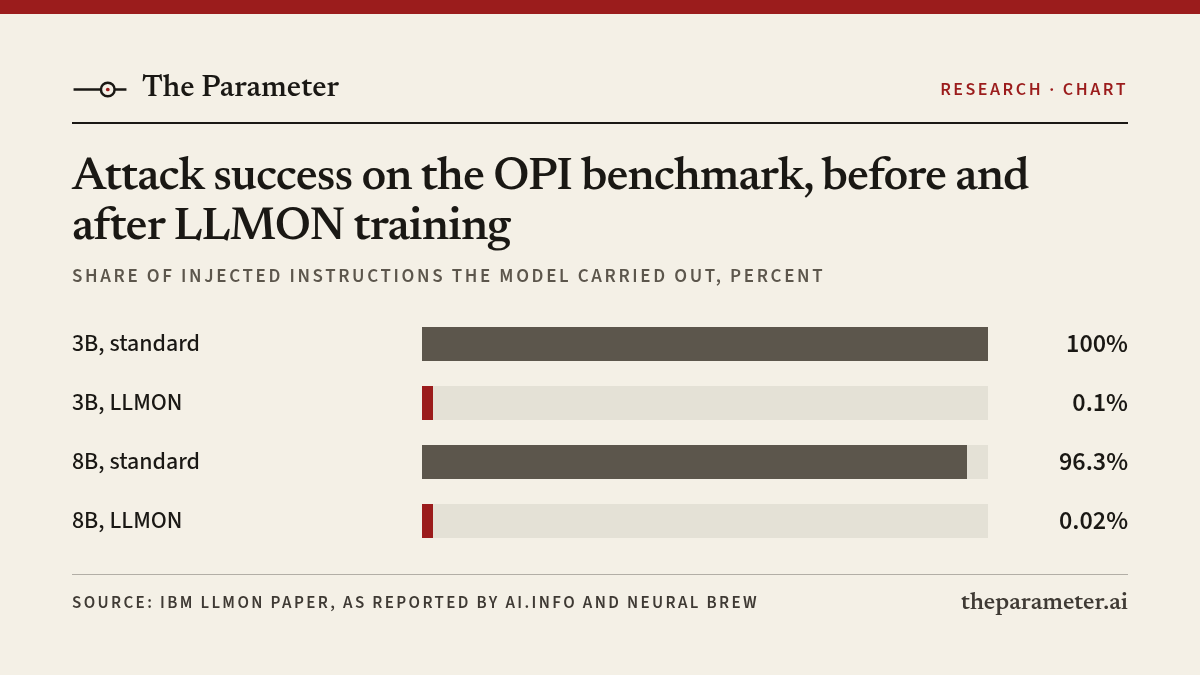
On the OPI benchmark, which hides injected instructions in the data of ordinary language tasks, IBM says standard models carry out the injected instructions with high probability, while the LLMON models "practically eliminate" the problem. IBM says they avoid 47% more attacks than the best frontier model it tested and 95% more than the best open model. It did not name those models.
The underlying paper gives the figures, as reported by AI.info and Neural Brew: attack success fell from 100% to 0.1% for the 3B model and from 96.3% to 0.02% for the 8B model on OPI. On ASB, where the attack arrives in an agent's tool output, success fell from 99.2% to 5.6% and from 52.8% to 3.1%.
The limits
IBM is direct about what this is not. It calls the release a preview for exploration, not production. It says the separation is "a learned behavior, not an enforced guarantee," and the model card warns against relying on it as the only defense for an agent with access to sensitive systems. The benchmarks test static injections; IBM says it is still working on adaptive attacks that unfold over several turns. AI.info reports that gains were much smaller against direct and multi-turn attacks in a separate red-team evaluation, and that the delimiters add roughly 7% to 15% to prompt length.
Why it matters
Prompt injection is the main reason companies hesitate to let AI agents read email, browse the web or act on tool output unsupervised. Most defenses today are filters bolted on around the model. IBM's approach builds the boundary between commands and content into the model's training. It is early and small-scale, but if the results hold up on larger models and harder attacks, it points toward agents that are safer by design rather than by patch.
Sources
- LLMON: An LLM-Native Markup Language, now in Granite 4.1 3B and 8B — IBM Granite on the Hugging Face blog
- LLMON: An LLM-native Markup Language to Leverage Structure and Semantics at the LLM Interface — arXiv
- IBM Trains Granite Models to Resist Prompt Injection — AI.info
- IBM Trains Two Small Granite Models to Separate Instructions and Data to Resist Prompt Injection — Neural Brew, Nov. 2026
The Parameter reports only what its sources support. Corrections: hello@theparameter.ai.