Nvidia's Vera Rubin debuts in MLPerf Training with up to 2x the per-GPU speed of GB300
In MLCommons' latest training round, Nvidia's new rack-scale system trained the DeepSeek-V3 benchmark in 4.14 minutes on 1,024 GPUs. A record 24 organizations submitted results.
Nvidia's next-generation Vera Rubin platform appeared in an industry benchmark for the first time on Monday, when MLCommons published the results of MLPerf Training v6.1. Nvidia says its Vera Rubin NVL72 system delivered up to twice the per-GPU training performance of its current GB300 NVL72 at the same GPU counts.
MLPerf Training measures how long a system takes to train a set of models to a target accuracy. MLCommons, the consortium that runs it, describes the benchmarks as peer-reviewed and open-source. Results are submitted by vendors and cloud providers.
The headline numbers
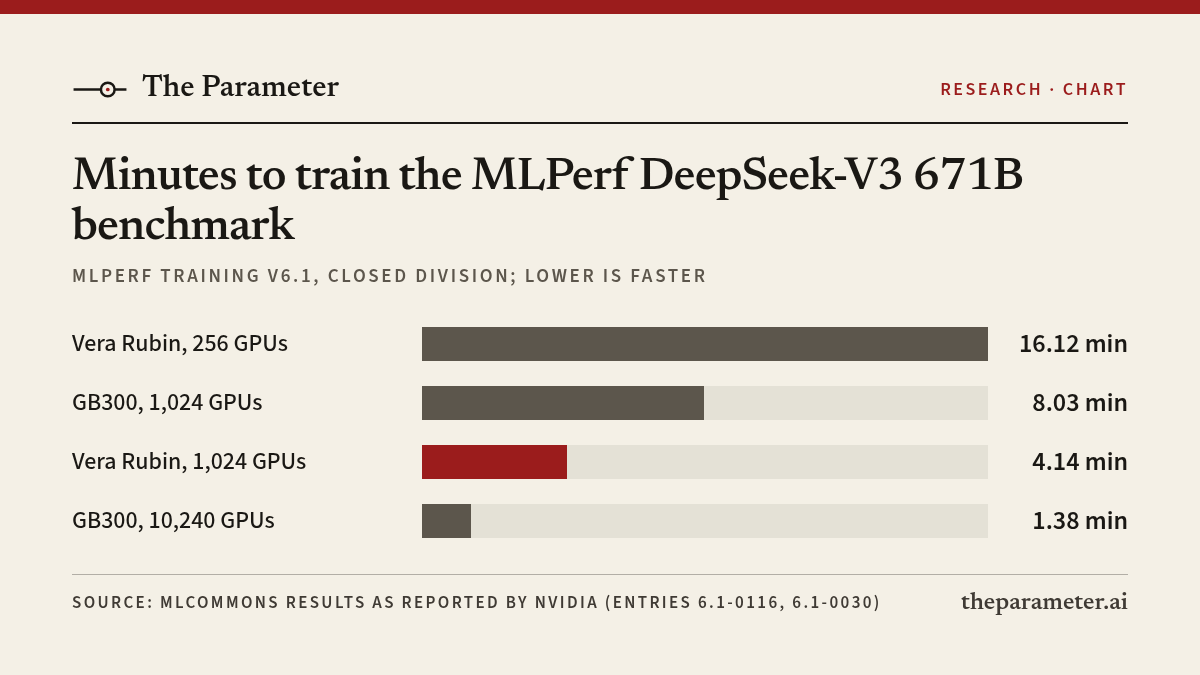
On the round's largest language model test, DeepSeek-V3 with 671 billion parameters, Vera Rubin NVL72 finished in 4.14 minutes on 1,024 GPUs across 16 racks, according to Nvidia's technical blog. GB300 NVL72 took 8.03 minutes on the same number of GPUs.
Nvidia's per-benchmark comparison shows smaller gains elsewhere: 1.4x on the new Qwen3.5-397B reinforcement-learning test and on the DLRMv4 recommender, 1.5x on Llama 2 70B fine-tuning and FLUX.1 image generation, and 1.6x on gpt-oss 20B and Llama 3.1 8B.
Scaling held up. Going from 256 to 1,024 Vera Rubin GPUs cut DeepSeek-V3 training time from 16.12 minutes to 4.14 minutes, a 3.9x speedup on four times the hardware, or about 97% scaling efficiency, according to Nvidia's submission notes published by MLCommons. The fastest absolute result of the round still came from the older generation: GB300 systems trained DeepSeek-V3 in 1.38 minutes on 10,240 GPUs.
A bigger, more varied field
MLCommons said 24 organizations submitted 153 systems and 250 results, records for the benchmark. Systems used Nvidia, AMD and Google accelerators, including the first Rubin-generation GPUs and Google's TPUv7 (Ironwood). Twelve systems used 1,000 or more accelerators, and 37% of systems were cloud-based, up from 29% in the previous round.
The round added two benchmarks. Qwen3.5-397B tests large-scale post-training with Group Relative Policy Optimization, the reinforcement-learning method used to teach models to reason and call tools. DLRMv4-HSTU replaces the older recommender benchmark.
CoreWeave, which says it was the only cloud provider to submit Vera Rubin results on DeepSeek-V3, said it trained the model in 17.65 minutes on 256 Rubin GPUs, 2.7x faster than its own GB200 NVL72 submission at the same scale.
The caveats
Nvidia says it was the only platform with results on every benchmark, so "sweep" partly reflects who chose to enter which tests. The per-GPU comparisons are Nvidia's own reading of MLCommons entries. Nvidia's separate claim of more than 10x throughput per watt on agentic inference, from the new MLPerf Endpoints benchmark, is labeled provisional and pending MLCommons verification.
Why it matters
Training time decides how many experiments a lab can run. A roughly 2x per-GPU jump on the largest mixture-of-experts test is the first independent-benchmark look at what buyers of Nvidia's next system can expect, ahead of Nvidia's quarterly results on Tuesday afternoon.
Sources
- MLCommons Releases MLPerf Training v6.1 Results — MLCommons, Nov. 16, 2026
- NVIDIA Vera Rubin NVL72 Achieves up to 2x Blackwell Ultra Performance in MLPerf Training v6.1 — NVIDIA Technical Blog, Nov. 16, 2026
- NVIDIA Sweeps MLPerf Training and Endpoints as Vera Rubin Debuts — NVIDIA Blog, Nov. 16, 2026
- MLPerf Training v6.1 Supplemental Discussion — MLCommons, Nov. 16, 2026
- CoreWeave becomes first cloud provider to deliver multi-rack NVIDIA Vera Rubin results in MLPerf Training v6.1 — CoreWeave, Nov. 16, 2026
The Parameter reports only what its sources support. Corrections: hello@theparameter.ai.